
Swarthmore student set to face trial over anti-genocide protests

Photo credits: James Shelton [The Swarthmore Phoenix]
Anti-Zionism campus protestors across the nation are being marked as ”anti-semitic” in a widespread and longstanding tactic from the pro-Israel lobby. At Swarthmore, an institution that prides itself on its social justice, the suppression of dissenting voices is all the more apparent.
Last spring, students and onlookers reported on the targeting of individuals by the college in response to organizing efforts demanding Swarthmore’s divestment from Cisco—a company that provides technology to Israeli military operations. Jace Boland is one of nine people facing misdemeanor trespass charges in response to the 4-day occupation of Swarthmore’s Trotter lawn during the closing weeks of the spring semester in 2025. The campus’s central lawn, was aptly named Hossam Shabat Liberated Zone by students in honor of the slain Palestinian journalist Hossam Shabat who was killed via airstrike bombing back in March 2025 by Israeli forces (Nearly two years after reports of former Swarthmore College professor Spencer Trotter’s desecration of Native American remains, and scientific racism, Swarthmore President Valerie Smith stated last winter that the lawn and hall that bear his name will be renamed).
Boland highlighted the unique environment at Swarthmore, noting that, “the student body has a history of supporting Palestine, including the passage of a BDS resolution,” says Boland referring to a 2019 resolution that was passed by the student government.¹(This resolution was voted on twice, the second of which took place behind closed doors, due to harassment of members). “During the first encampment, nearly a quarter of the student body participated,” according to Boland. “Given Swarthmore's significant $2.7 billion endowment and the widespread campus support for divestment, there is a strong sense that meaningful change is possible.”
¹(BDS is a international movement that call for the boycott, divestment, and sanctioning of companies and entities that support the Israeli apartheid regime).
Boland went on to explain that while it is disheartening, it often takes disciplinary action against students to shift public opinion, and that he remains focused on the wider context. He noted that despite the personal risk of suspension or criminal charges, the primary concern remains the ongoing onslaught of the Palestinian people. Responding to the repression he’s been met with:

Police presence at Swarthmore during the protest encampment. Photo Credits: Zack Kreines [The Swarthmore Phoenix]
“Why would I cry about being suspended? You know, it's like that's so clear. It's like they (Palestinians) don't have the option of ignoring protests, of ignoring organizing and studying to finish up to get their degree or whatever. They literally can't do that because their schools have been bombed like the universities are destroyed, that's not an option. And I think it's really important for people to make that connection and to just understand in perspective that the money that their institutions, the money that pays for their degree, the money that pays for the libraries that they study in, the money that pays for the books that they read and the professors that teach them is money that is made on a market that is predicated on the genocide of Palestinians.”
When questioned about the current climate at Swarthmore, particularly regarding the disconnect between the college’s social justice image and its response to recent protests Boland highlighted how the college has historically managed its public image through "greenwashing,” or misleading the public through imagery and campaigns that conceal their true environmental impacts. While student-led movements like Mountain Justice at Swarthmore organized for fossil fuel divestment, the administration opted for sustainability branding rather than addressing the endowment itself. This pattern appears to be repeating now. Despite its social justice facade, the college's power remains concentrated in the Board of Managers—which operates more like a corporate body focused on financialization rather than educational or ethical values, according to Boland.
Boland describes the charges to be an escalation in disciplinary actions and administrative responses to student activism at Swarthmore College since Fall 2023. Following the initial sit-in of the administrative building, the administration threatened to cut funding for a coalition of student affinity groups, including Black and Latino orgs. This pattern continued through spring 2024, when an encampment was disbanded after administrators threatened to suspend student leaders and revoke their funding and employment.
Over the summer of 2024, 25 students involved in Palestine organizing—primarily students of color, particularly Black and Arab—faced extensive disciplinary hearings. While many received minor administrative sanctions, the process was marked by aggressive and discriminatory conduct. Notably a queer, Arab, female student faced a 100-page evidence packet that repeatedly characterized her as "aggressive" and "threatening."
In February 2025, A group conducted a sit-in at the disciplinary administrator’s office. The college responded by using facilities staff and campus safety from Widener to encircle the building for 11 hours, ending the demonstration with threats of mass suspension. Subsequently, the aforementioned student was suspended on an unprecedented “assault” charge for using a bullhorn indoors. This decision has caused significant hardship due to her financial and housing precarity and has galvanized student support against what they view as targeted retaliation.
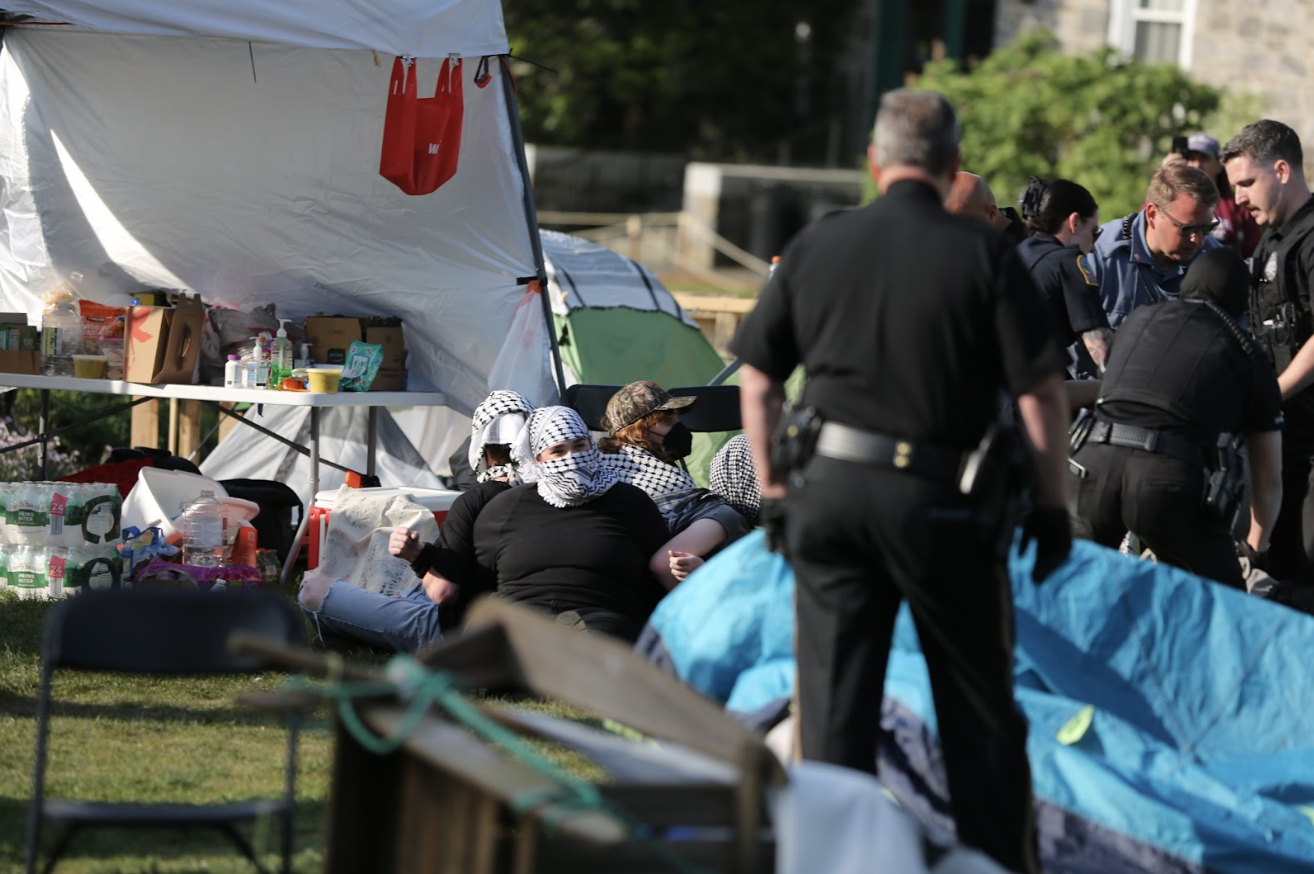
Hossam Shabat Liberated Zone protestors linked together as police begin to dismantle the encampment. Photo credits: Zach Kreines [The Swarthmore Phoenix]
There is a significant disconnect between the college’s progressive image and the board’s actual influence. The administration utilizes disciplinary backchannels to manage pro-Palestine organizing in order to satisfy pressure from board leadership.
Boland’s analysis of the professional ties of board members to organizations like Goldman Sachs, Lockheed Martin, and Israeli tech advancement suggests that protecting specific interests has prioritized order over the college's commitment to social justice. This shift is evident in the current crackdown on campus protests.
A telling example of their "profit over people" mindset was the administration’s recent celebration after lobbying the Trump administration for an endowment tax cut. Publicly touting a tax break—even one tied to legislation that expanded harmful systems like ICE—demonstrates where the college’s true priorities lie.
It is becoming increasingly clear that while the internal campus culture may value social justice, the institution’s financial and administrative power structures remain deeply rooted in capitalist and colonialist frameworks.
Boland reflected on how emotionally moving the Hossam Shabat Liberated Zone (HSLZ) was, describing the encampment as a space defined by “profound solidarity, despite being under immediate threat” following the building occupation in February. Boland highlighted how the high stakes actually deepened the connection between those present. He noted that while fewer people attended due to the risks, the environment was transformative. He was particularly moved by the way the community grew as people from Philadelphia, the suburbs, and the alumni network arrived to stand in solidarity against the ongoing genocide in Palestine.
Jace also pushed back against the administration's "outside agitator" narrative. He explained that the visitors—including educators and organizers from groups like Abolition School—brought workshops, knowledge, and acts of care, such as a friend who managed to bring electricity to the site. To him, this was an act of opening up a privileged campus to shared learning and mutual support. One of his most striking memories was being arrested alongside the rest of the “Swarthmore 9.”
“Aside from one other student, I had never met the others before,” he said. The protests displayed an unwavering commitment to Palestinian rights amongst organizers and students across institutions who were willing to risk arrest.
“There’s something about being together in solidarity, in a space that you’ve created together around a common goal that is constantly under outside threat,” in speaking of this experience Boland says “It changed my life.” Boland is awaiting trial which starts on June 29. Supporters of Boland are urging the public to demand Swarthmore drop the charges and sustain an academic boycott of the college.
Individuals from the W.E.B. DuBois Movement School for Abolition & Reconstruction, a radical learning program were also present at the HSLZ during the encampment. When asked about students who persisted through the encampments despite potential repercussions, Geo Maher of Abolition School stated:
“We at Abolition School are incredibly proud of all of the students and community members, many of them Abolition School alumni, who took it upon themselves to bravely confront colleges and universities complicit in Israel's ongoing genocide. They represent the best of what we teach: that we all have a responsibility to fight back against the inhumanity of this world while working together to build a new one.”
Regarding the Abolition School's specific role, he clarified:
“While Abolition School was not directly involved in organizing encampments which emerged spontaneously from the solidarity expressed by students and community members, we salute those who participated.” Furthermore he responded to two critical issues in terms of calls for divestment from Cisco: “We understand BDS to be a crucial tactic in a broader arsenal of resistance led by the Palestinian resistance on the ground, and we know that Cisco has been deeply complicit in Israeli settler colonialism.”
Lastly, Maher shared how censorship and repression against students affect society at large:
“It's no accident that the backlash against Palestinian resistance in the US targeted students directly. There's nothing more dangerous than when young people and students begin to break down the artificial walls separating academia from broader struggles. Repression seeks to silence this and enforce the genocidal status quo — we can't let them succeed.”
We also reached out to Professor Sabeen Ahmed, Assistant Professor of Philosophy at Swarthmore, regarding her perspective of the treatment of students.
Professor Ahmed describes her work as an interrogation of modern forms of power, specifically how liberal frameworks can mask domination and violence. When asked about the call to divest from Cisco, she provided the following response:
“I see calls for divestment—whether from Cisco, Palantir, Lockheed Martin, or other corporations and institutions implicated in the ongoing genocide against Palestinians—as one strategy within a much broader, internationalist tradition of anti-imperial and anti-colonial struggle. Historically, divestment campaigns have emerged not simply as symbolic gestures, but as efforts to expose and contest the material infrastructures that sustain colonial-racial systems of domination: financial networks, technological systems, and forms of capital accumulation that depend on militarization, dispossession, racialized violence, and ecological devastation.
What is distinctive about divestment calls by students is their exposure not only of individual companies, but the function of the university as an arm of U.S. empire. Universities often present themselves as neutral spaces of knowledge-production while remaining deeply entangled with state and corporate power through investment portfolios, research partnerships, defense contracting, and technological development. In that sense, calls for divestment are also demands for institutional self-reflection and accountability.
To me, what has been especially revealing is not merely the existence of these campaigns; as long as colonial violence exists, so, too, will student resistant movements. Much more interesting is the nature of the institutional responses to these campaigns. The rationalizations offered in defense of continued complicity—whether framed in terms of neutrality, fiduciary obligation, proceduralism, or the ‘complexity’ of the issue—illuminate the poverty of the university’s political imagination and the shallowness of its institutional commitments much more clearly than the protests themselves ever could. More pressingly, they also reveal which forms of violence are rendered administratively acceptable, which relationships to power are normalized, and which demands for justice are treated as unreasonable or disruptive. Those justificatory logics are much more worthy objects of critique and interrogation”
When we asked about the treatment of students who dare to call out these systems:
“Calls for divestment are part of a longstanding tradition of antiwar, anti-imperial, and anticolonial organizing, and they represent one of the primary forms of nonviolent political action available to students within ostensibly liberal democratic institutions. Historically, movements for divestment—whether against apartheid South Africa or other systems of state violence—have often been met with attempts to recast political dissent as disorder, extremism, or threat. We are obviously seeing as similar dynamic today: treating divestment calls as racist, antisemitic, violent, or harmful is a strategy of deflection, displacement, and deferral that emerges the moment that those calls expose the limits of liberal equality, responsibility, and care. Over the last two years, we have seen heightened surveillance, disciplinary measures, censorship, and forms of selective enforcement that have fallen disproportionately on students from marginalized communities and on those most visibly associated with anti-colonial or anti-racist politics (which are, not coincidentally, two often overlapping categories). We have also seen attacks on faculty and staff—many of whom are also from marginalized communities—who serve as intellectual mentors and sources of support for students attempting to engage in principled, nonviolent protest. By eliminating these structures of support, institutions are producing climates of isolation, fear, and political precarity that undermines not only meaningful dissent, but the ideals and integrity they claim to uphold. At the same time, removing avenues for intellectual guidance, mediation, and principled engagement all but guarantees that student frustration and political alienation will increasingly take forms that institutions later deem “disruptive.” Universities cannot systematically delegitimize, isolate, and punish nonviolent political organizing while simultaneously expressing surprise when dissent emerges in more confrontational or less institutionally manageable forms—though perhaps that is precisely the point.”
Author’s note:
It is vital to remain vocal in exposing Zionism as the late great Kwame Ture once said “an unjust, illegal, immoral, and racist system.”. Advocacy for the Palestinian state belonging to the Palestinian people often results in surveillance, censorship, and doxxing, as anyone who challenges the established system or settler colonial state of Israel becomes a target.
—-Lourd.Knows